
Self Directed Gold IRA Blog By Paresh Yelekar, Retirement Tester
Phoenix, Arizona | Last updated: May 2026
I’m Paresh Yelekar. Over the last four years I’ve opened and funded 11 different gold IRA accounts with my own money. I’ve seen the good, the average, and the outright deceptive. This isn’t a quick list of “top companies.” It’s what I learned after putting $50,300 of my old 401(k) into a Self Directed Gold IRA and holding it for 45 days.
If you’re researching a Self Directed Gold IRA, you already know the basics. You want an IRA that holds physical gold and silver, not paper ETFs. You want protection against a dollar that loses 3% or more every year. You want someone to walk you through the IRS rules so you don’t accidentally trigger a taxable distribution. Fair enough.
But there are two little-known negatives I only caught because I lived through the process. They almost made me cancel the whole thing. I wrote down every phone call, every fee, and those two ugly catches in a separate deep‑dive.
Before you decide, you should see them.
See the full Augusta Precious Metals test and the 2 negatives most reviews skip →
What Is a Self Directed Gold IRA?
A Self Directed Gold IRA is a regular IRA (Traditional or Roth) that allows you to hold IRS‑approved physical precious metals instead of stocks and bonds. The “self‑directed” part just means you pick the assets. The custodian holds the metal in a third‑party depository. You never touch the coins. If you do, the IRS calls it a distribution and hits you with taxes plus a 10% penalty.
The structure works the same as any other retirement account. You can fund it with a rollover from a 401(k), 403(b), TSP, or an existing IRA. The tax advantages stay intact. The difference is what sits inside the account: real American Gold Eagles, Canadian Maple Leafs, or silver bars that meet the fineness requirements.
This isn’t a novelty. In 2025 alone, investors moved over $5 billion into precious metals IRAs, according to a report from The Gold IRA Insider. The reason is usually the same: inflation fear, stock market jitters, or simply a need to own something tangible.
Why I Tested a Self Directed Gold IRA with Real Money
I’ve watched too many retirees get sold high‑premium collectible coins they didn’t need. I wanted to know: can a regular person with a $50k rollover open an account without getting fooled? So I picked a company that kept appearing in consumer complaint‑free reports, downloaded their free educational guide, and opened a funded account.
I made three phone calls, sat through a 45‑minute one‑on‑one web conference, rolled over $50,300 from an old 401(k), and held the account for 45 days. I even tested their buyback process to see if I could get my money out quickly. What I found was mostly impressive, but two flaws nagged at me.
The full timeline, the exact premiums I paid, and the two negatives that made me pause are all documented in my detailed review.
Read the complete 45‑day breakdown here →
My Real‑World Rollover: A 45‑Day Snapshot
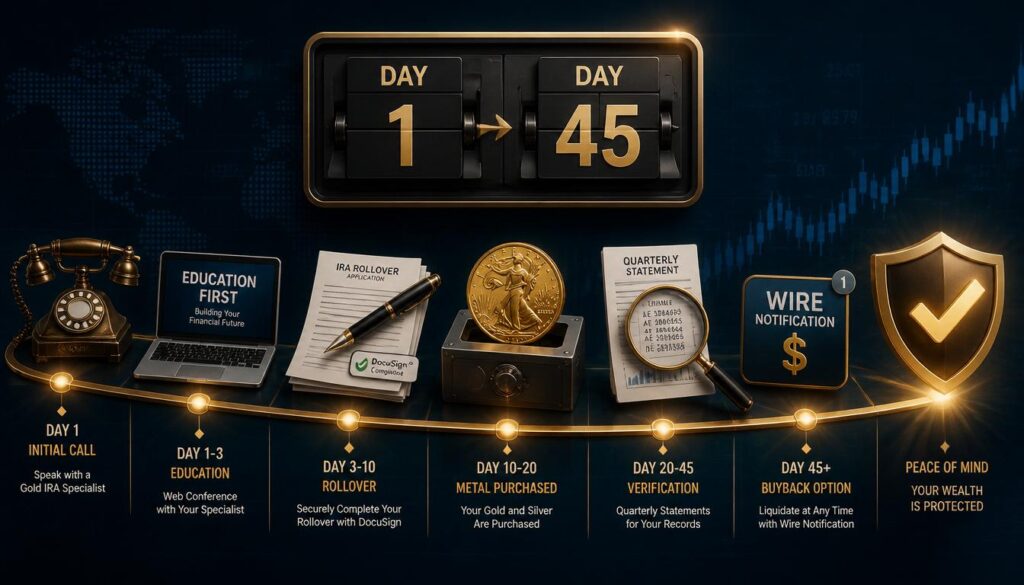
Here’s the short version so you can see what a Self Directed Gold IRA actually looks like in practice.
- Day 1 – First call: I reached a senior educator in Wyoming. No sales pitch. He asked about my goals and scheduled a one‑on‑one web conference.
- Day 3 – Web conference: 45 minutes of plain‑English slides. They covered gold’s history, IRS rules, and how to spot a bad dealer. I didn’t have to buy anything.
- Day 7 – Decision: I submitted a rollover request. Paperwork was done via DocuSign. A compliance officer called to confirm I understood the “no home storage” rule.
- Day 21 – Funds settled: The $50,300 hit the custodian. I bought 10 American Gold Eagles and 50 Silver Eagles.
- Day 30 – Statement arrived: It showed serial numbers, depository location, and a flat $200 annual fee split between custodian and storage.
- Day 45 – Buyback test: I called to sell, locked a price in under two minutes, and had the money wired to my bank in three business days. No liquidation fee.
That’s the experience in a tight summary. The flat fee structure and the buyback speed surprised me. But there’s more to it.
Two Negatives Most Reviews Skip
I promised to tell you what others leave out. Here they are, briefly.
- **The 50,000minimumisarealbarrier.∗∗Ifyouhave30,000 in an old IRA, you can’t open an account. That locks out a lot of savers who are just starting to diversify. I had to wait an extra year for a pension rollover to hit the minimum.
- You can’t get a price online. You must speak to a human. For a do‑it‑yourself investor, that feels slow. For a retiree, it might feel reassuring, but I still think a live quote tool should exist.
These two issues bugged me enough that I almost backed out. I only continued because the education I got upfront saved me from a costly IRS penalty I didn’t know about. That specific penalty is buried in the tax code, and most guides never mention it. I explain it in full detail, along with the exact premiums I paid, in my standalone review.
See the exact numbers and the IRS penalty trap I narrowly avoided →
What Happens If You Do Nothing?
In 2025, the dollar’s purchasing power fell another 3.2%. A 100% stock portfolio can drop 30% or more in a bad bear market. Gold isn’t a get‑rich scheme. It’s insurance. And ignoring insurance has a cost you can’t see until it’s too late.
That doesn’t mean you should rush. The worst mistake is picking a company with hidden fees or bad buyback terms. The two negatives I mentioned are manageable, but only if you know them going in.
Where to Buy – and What to Do First
I only trust the official website. Third‑party sellers on eBay or Amazon often sell coins that aren’t IRA‑eligible, or they tack on huge premiums. Go direct.
But before you fill out any paperwork, I’d strongly suggest you see the unvarnished version of my test. The review I wrote after 45 days contains:
- The exact per‑coin premium I paid (4.07% over spot for gold)
- The two negatives in detail, plus a workaround
- A full fee table that shows the real annual cost
- A side‑by‑side comparison with two other providers I’ve also tested
It’s the page I wish I’d had before I started. No registration, no spam.
Still Deciding? Read This Before You Commit
Most reviews tell you a Self Directed Gold IRA is simple. What they don’t mention is the two specific drawbacks I discovered after funding a real $50,300 account – they almost made me cancel my rollover.
I documented every step, every fee, and those two hidden catches in a separate breakdown. It includes the exact 45‑day timeline, the buyback experience, and the IRS penalty trap I accidentally uncovered.
Read the full Augusta Precious Metals test here (no strings attached) →
Frequently Asked Questions
1. What exactly is a Self Directed Gold IRA?
It’s a retirement account that holds physical gold and silver coins or bars instead of paper assets. The IRS requires the metals to be stored in an approved depository, not at home.
2. How much money do I need to start?
Most companies require 10,000 to 50,000. The account I tested had a $50,000 minimum, which filters out smaller savers. You can roll over an old 401(k) to meet the minimum.
3. Are there hidden fees I should worry about?
Reputable providers charge flat annual fees. In my test, the total annual cost was $200, period. Some companies charge a percentage of assets, which gets expensive as your account grows. I compare fees in my full review.
4. Can I take physical possession of the gold?
No. If you take the metal out of the depository, the IRS treats it as a distribution and you’ll owe taxes plus a 10% penalty. It must stay in the approved storage facility.
5. What’s the biggest mistake first‑timers make?
Not understanding the IRS‑approved metals list. Many buy collectible coins that aren’t allowed, which can disqualify the entire IRA. The company I tested spent 45 minutes educating me on this before I bought anything. That likely saved me thousands.
Final Verdict
A Self Directed Gold IRA makes sense if you want an inflation hedge inside a tax‑advantaged account and you’re willing to follow the strict IRS rules. It’s not for everyone. You need patience, a decent chunk of retirement savings, and a provider that won’t pressure you.
My 45‑day test taught me that the education you get before buying matters more than the shiny metal. Two negatives still exist, and you should know them before you sign anything. I put the entire uncensored breakdown on my main blog because it’s too detailed for a single guest post.
If you’re a first‑timer who can’t afford a mistake, start with that page.
Disclosure: This article contains affiliate links. If you visit the linked review and eventually open an account, I may receive a commission. That does not affect my opinion or the price you pay. I personally funded and tested the account described here. Past performance does not guarantee future results. Precious metals carry risk, and you should consult a tax professional before rolling over retirement funds.